
October 21, 2026
Dental Implants – Frequently Asked Questions (FAQ)
Thinking about dental implants usually starts with a long list of questions. How long do they last? Will it hurt? Am I too old, or do I have enough bone? These are smart questions to ask before any surgery, and the answers should come from evidence, not guesswork. In this guide, Dr. Shreed Sista and the team at Dentiq Dentistry Houston answer the dental implant questions patients ask most, with links to the published research behind each answer.
Every mouth is different, so use this as a starting point. Your consultation is where these answers become specific to you.
What Are Dental Implants and How Do They Work?
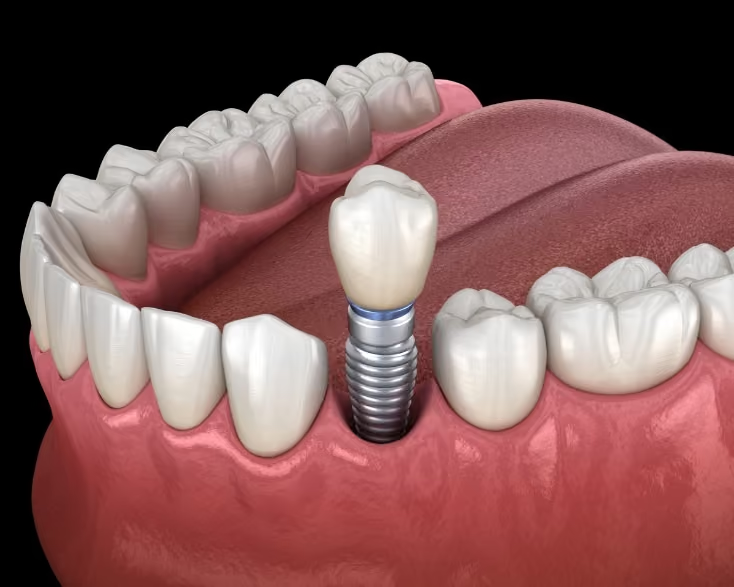
A dental implant is a small post, usually made of titanium, that is placed in the jawbone where a tooth root used to be. Over the following weeks and months, bone grows tightly against the implant surface. This process is called osseointegration, and it is what makes an implant stable enough to chew on like a natural tooth.
Once the implant has fused with the bone, a connector called an abutment is attached, followed by the visible tooth. An implant can support:
- A single crown to replace one missing tooth
- A bridge to replace several teeth in a row
- A full arch of fixed teeth, such as All-on-4 dental implants
- A removable denture that snaps securely onto implants
Because the implant replaces the root as well as the crown, it does not rely on neighboring teeth for support. That is one of the main differences between an implant and a traditional dental bridge, which requires the teeth on either side to be filed down for crowns.
How Long Do Dental Implants Last?
Long-term studies show that implants are one of the most durable treatments in dentistry. A systematic review in the Journal of Dentistry pooled studies that followed patients for at least 10 years and found an implant survival rate of 96.4%. When the authors adjusted for patients lost to follow-up, the more conservative estimate was still 93.2% (Howe et al., 2019).
Looking even further out, a 2024 meta-analysis of 20-year data concluded that roughly four out of five implants are still in place two decades after placement (Kupka et al., 2024).
The implant itself is built to last. The crown on top may wear over time and occasionally need replacing, much like any other restoration. How long your implant lasts also depends on factors you control, including home care, regular checkups, and not smoking.
Are Dental Implants Painful?
Most patients are surprised by how manageable implant surgery is. The area is fully numbed during the procedure, so you should feel pressure but not pain. A systematic review of pain control after implant surgery notes that discomfort afterward is usually mild to moderate, with some swelling being a normal part of healing (Melini et al., 2021).
Here is what most patients can expect after placement:
- Mild soreness and swelling for the first few days
- Relief with over-the-counter or prescribed pain medication
- A soft-food diet for a short period while the area heals
- A return to normal routines within a day or two for most single-implant cases
If dental anxiety is holding you back, sedation can help. Dentiq Dentistry Houston offers nitrous oxide and IV sedation so you can stay relaxed throughout your procedure.
Who Is a Good Candidate for Dental Implants in Houston?
Most adults who are missing one or more teeth can be considered for implants. In general, a good candidate has healthy gums, enough jawbone to hold the implant, and overall health that allows for a minor surgical procedure.
Age by itself is rarely the deciding factor. A systematic review of patients aged 65 and older found implant survival of 97.7% at one year and 96.2% at five years, and the authors concluded that age alone should not limit implant treatment (Srinivasan et al., 2017).
Some conditions call for extra planning rather than ruling you out:
- Smoking — A meta-analysis of more than 150,000 implants found that implants in smokers had about 2.4 times higher odds of failure than implants in non-smokers (Mustapha et al., 2021).
- Diabetes — Well-managed blood sugar matters. Diabetes is one of the systemic factors most consistently linked with inflammation around implants (Scarano et al., 2023).
- Gum disease — Active periodontal disease should be treated first. A history of periodontitis is strongly associated with later implant problems (Scarano et al., 2023).
- Bone loss — If the jaw is too thin or short, bone grafting can rebuild the site before or during implant placement.
At your consultation, a 3D cone beam CT scan shows your bone height, width, and nearby structures so the implant can be planned precisely.

What If I Don't Have Enough Bone?
Bone needs stimulation from a tooth root to stay healthy. After a tooth is removed, the jawbone starts to shrink. A systematic review in Clinical Oral Implants Research found that within six months of an extraction, the ridge lost an average of 3.8 mm in width and about 1.2 mm in height, with most of the change happening in the first three to six months (Tan et al., 2012).
This is why timing matters. Replacing a tooth sooner often means less bone has been lost. If bone has already shrunk, there are reliable ways to rebuild it:
- Bone grafting to add volume at the implant site
- Ridge augmentation to restore the shape of the jaw
- Socket preservation at the time of extraction to limit future bone loss
How Long Does the Dental Implant Process Take?
Timelines vary based on whether you need extractions or grafting, and on how quickly your bone heals. Traditionally, implants are left without biting load for roughly three to eight months while osseointegration takes place (Esposito et al., 2013).
A typical single-implant journey looks like this:
- Consultation and 3D scan — Dr. Sista reviews your health history, takes a CBCT scan, and builds your treatment plan.
- Extraction and grafting, if needed — Some sites need a healing period before the implant goes in.
- Implant placement — The implant is placed in a short procedure under local anesthesia, with sedation if you prefer.
- Healing and osseointegration — The bone bonds to the implant over the following months.
- Final crown — Your custom tooth is attached and adjusted for a natural bite.
In some cases, a temporary tooth can be attached the same day. The Cochrane review above found no convincing evidence of a clinically important difference in failure rates between immediate loading and conventional loading in the trials it studied, although the authors rated the evidence as low quality (Esposito et al., 2013). Whether same-day teeth are right for you depends on your bone and how stable the implant is at placement.
How Do I Take Care of Dental Implants?
Implants cannot get cavities, but the gums and bone around them can still become inflamed. Early inflammation of the gum tissue is called peri-implant mucositis. If it progresses and starts to affect the bone, it becomes peri-implantitis.
Good daily care and regular professional maintenance make a measurable difference. In studies cited in a 2023 clinical review, patients who kept up with regular maintenance visits had lower rates of peri-implantitis, for example 18% compared with 43% in one study (Scarano et al., 2023).
To protect your implant:
- Brush twice a day with a soft-bristled brush, including along the gumline
- Clean around the implant daily with floss, an interdental brush, or a water flosser
- Keep your dental cleanings and exams on schedule
- Avoid smoking and vaping
- Wear a night guard if you clench or grind your teeth
How Much Do Dental Implants Cost?
The cost of an implant depends on how many teeth are being replaced, whether you need extractions or grafting, and the type of final restoration. A single tooth, an implant-supported denture, and a full arch of fixed teeth are very different treatments with very different price ranges.
For current pricing, see our dental implant cost page. We also offer financing options to spread treatment into manageable monthly payments, and our team can help you check your dental insurance benefits.
Conclusion
Dental implants are backed by decades of research showing high long-term survival, manageable recovery, and results that look and function like natural teeth. Age is rarely a barrier, and issues like bone loss, gum disease, or diabetes can usually be addressed with the right planning. If you are weighing your options for missing teeth, Dr. Shreed Sista and the team at Dentiq Dentistry Houston can walk you through what dental implants in Houston would look like for your smile. Book Now to schedule your appointment with our team.
Frequently Asked Questions
Can a dental implant fail?
Yes, although it is uncommon. Long-term studies show more than 9 in 10 implants are still in place after 10 years. Failure risk is higher in smokers, people with uncontrolled diabetes, and patients with untreated gum disease. Good home care and regular maintenance visits help lower that risk.
Do dental implants look natural?
Yes. The visible crown is custom-made to match the shape and shade of your surrounding teeth. Because the implant comes out of the gum like a natural root, a well-planned implant tooth is very hard to tell apart from your own teeth.
Can I get an implant right after a tooth is pulled?
Sometimes. If the site is free of infection and has enough healthy bone, an implant can occasionally be placed the same day as the extraction. Other sites need grafting and a healing period first. A 3D scan helps Dr. Sista decide which approach is safest for you.
Are implants better than dentures?
Implants are fixed in the bone, so they do not slip and they help preserve the jawbone. Traditional dentures rest on the gums and can loosen as the bone shrinks. Many denture wearers choose implant-supported dentures as a middle ground that adds stability without replacing every tooth individually.
How many implants do I need to replace all my teeth?
A full arch of teeth can often be supported by as few as four implants, which is the idea behind All-on-4 treatment. The exact number depends on your bone volume and bite. Your treatment plan will specify how many implants are needed for long-term stability.
References
- Howe MS, Keys W, Richards D. Long-term (10-year) dental implant survival: A systematic review and sensitivity meta-analysis. Journal of Dentistry. 2019;84:9–21. University of Liverpool Repository
- Kupka JR, König J, Al-Nawas B, Sagheb K, Schiegnitz E. How far can we go? A 20-year meta-analysis of dental implant survival rates. Clinical Oral Investigations. 2024;28(10):541. PubMed Central
- Melini M, Forni A, Cavallin F, Parotto M, Zanette G. Analgesics for dental implants: A systematic review. Frontiers in Pharmacology. 2021;11:634963. doi:10.3389/fphar.2020.634963
- Srinivasan M, et al. Dental implants in the elderly population: A systematic review and meta-analysis. Clinical Oral Implants Research. 2017;28(8):920–930. University of Geneva Archive
- Mustapha AD, Salame Z, Chrcanovic BR. Smoking and dental implants: A systematic review and meta-analysis. Medicina. 2021;58(1):39. PubMed Central
- Scarano A, Khater AGA, Gehrke SA, et al. Current status of peri-implant diseases: A clinical review for evidence-based decision making. Journal of Functional Biomaterials. 2023;14(4):210. PubMed Central
- Tan WL, Wong TLT, Wong MCM, Lang NP. A systematic review of post-extractional alveolar hard and soft tissue dimensional changes in humans. Clinical Oral Implants Research. 2012;23(Suppl 5):1–21. University of Hong Kong Repository
- Esposito M, Grusovin MG, Maghaireh H, Worthington HV. Interventions for replacing missing teeth: different times for loading dental implants. Cochrane Database of Systematic Reviews. 2013;(3):CD003878. Cochrane Library